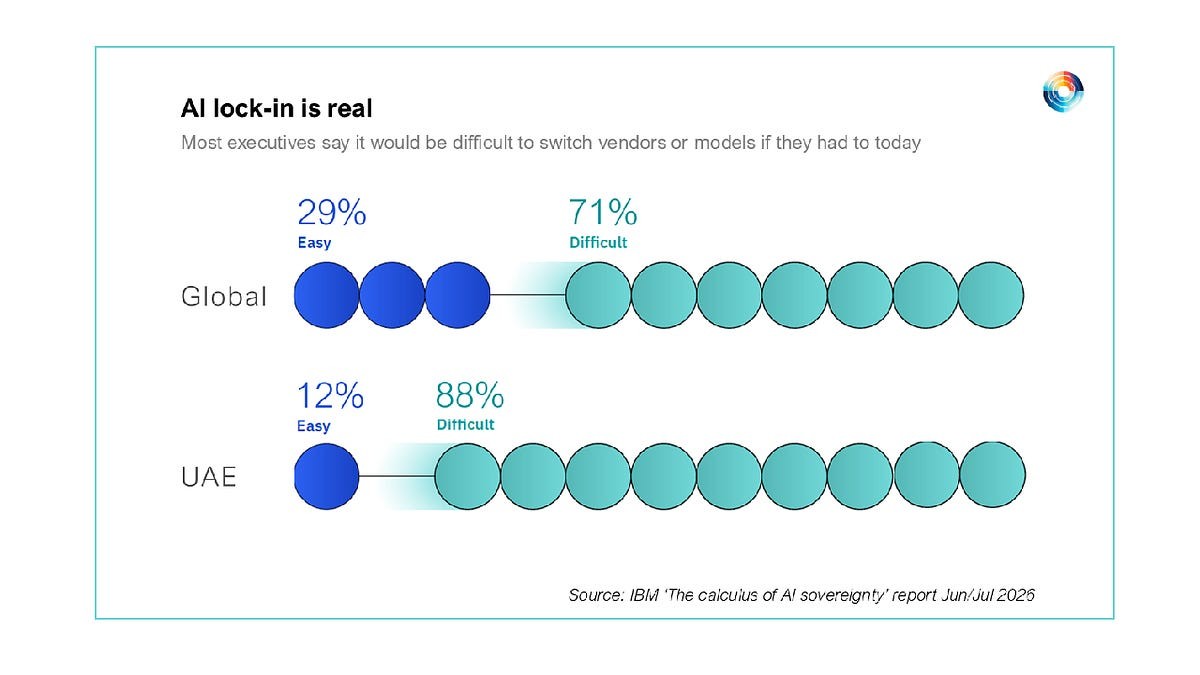
Eighty-eight percent.
That’s the portion of UAE executives who say flipping their primary AI vendor today would be a nightmare.
Ninety-six percent don’t even know how deep the dependency runs.
This isn’t a case of lazy management. It’s the result of haphazard scaling. A new report from the IBM Institute for Business Value (IBV) strips away the corporate gloss surrounding artificial intelligence integration in the region. The verdict is harsh. Companies have built AI ecosystems that are brittle, opaque, and painfully hard to exit.
The study, titled The Calculus of AI Sovereignty, polled 1,000 top decision-makers across 16 nations. When you look closely at the UAE data, it reveals a sector sprinting ahead but tripping over its own shoelaces.
The Multivendor Myth
Here is where the disconnect happens. Most organizations in the Emirates say they run intentional, multivendor AI environments. Some 82% claim they aren’t putting all their eggs in one basket. Globally, that number is slightly lower at 73%.
So why do leaders feel trapped?
Because that diversity is accidental.
It wasn’t a deliberate architectural choice. It was what happened when departments bought tools on a need-meets-now basis, often inheriting legacy setups they couldn’t tear down. The IBV study notes this accumulation happens because teams prioritize function over integration strategy.
“Diversity is largely accidental, perhaps the result of inherited decisions rather than deliberate strategy.”
Try moving. Go on.
Take a core AI system to a competitor. For 80% of these executives, it means staring at a calendar that refuses to budge for at least six months. UAE leaders estimate the average transfer of training data and operational information will take roughly 150 days. That isn’t flexibility. That’s hostage status.
The Cost of Not Knowing
You cannot fix what you do not measure. But the vast majority of UAE C-suite executives cannot measure their own dependencies.
Only a small fraction of the 16-country group understands how their models, infrastructure, and vendors tie into each other. Globally, just 9% claim to understand these links. In the UAE, 96% admit to a fog of war when looking at their stack.
Consequently, disruptions happen more frequently. The average organization reported seven AI-related operational interruptions in the past two years. That’s slightly worse than the global average of six. If a vendor goes down for seven days? Eighty-four percent of respondents say the damage would be severe or critical.
It gets worse when compliance enters the room.
Data sovereignty isn’t just a legal checkbox for tech firms in the region; it’s a daily hurdle. Seventy-four percent of UAE respondents cite challenges in meeting residency requirements across borders. That figure beats the global average of 68%. Geographical borders make clean data movement messy, especially when the underlying vendor contracts weren’t drafted with cross-jurisdictional mobility in mind.
Buying Security With Dollars?
Faced with this fragility, leadership is willing to pay.
Ninety percent-plus loyalty isn’t just stubbornness; it’s fear of downtime. In fact, 78% of UAE execs would tolerate a 20% spike in costs if staying put preserved their strategic options. They’d rather bleed money than bleed operations. Globally, the number sits at 72%.
But paying the vendor lock-in premium is a bad hedge.
True power in AI adoption doesn’t come from the biggest contract. It comes from agility.
The Path Forward: Selective Control
Global organizations that have actually tamed their stacks—those with genuine control—see something interesting. Their operating profits from AI-driven initiatives are protected 55% better from disruption compared to peers.
Only 7% of the surveyed firms currently operate at this level.
IBM suggests the answer isn’t a radical, messy breakup with every provider. Chasing “full control everywhere” is a recipe for stagnation. The proposed strategy is selective AI sovereignty.
This means tiering systems based on actual risk.
1. Mission-Critical Infrastructure: Invest heavily in flexibility here. Fraud engines. Real-time processing. These need to be switchable if a vendor fails.
2. Commodity Tasks: Let go. For transcription or basic translation tasks where switching costs are lower and vendor impact on core risk is minimal, dependency is acceptable.
Enterprises currently let AI make about 25% of operational decisions. They expect that share to hit nearly 48% by 2030 as artificial intelligence adoption grows faster across industries.
You don’t get to triple that exposure and still claim ignorance about where your data lives or which model holds the keys. The era of blind AI deployment is closing. The cost of admission for the next decade is technical transparency.
The UAE has the capital and the ambition. What’s missing is the architectural discipline to back it up.