Nvidia is taking its hardware to places most of us will never see. Not Mars. Not even deep space. The moon.
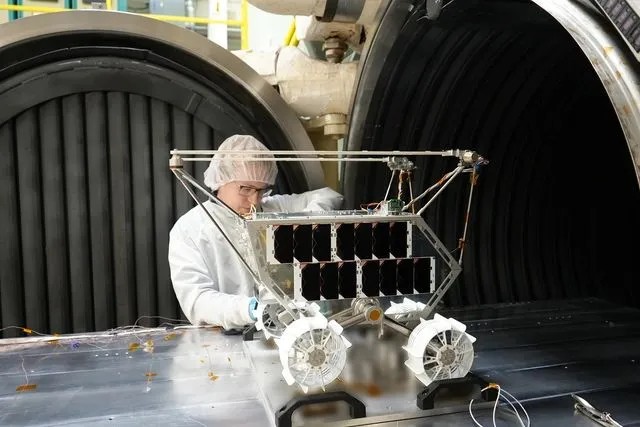
It’s a shift in strategy that moves GPUs from cloud servers to craters. Lunar Outpost, a startup focused on robotic infrastructure for the moon, announced on Thursday that its upcoming rover will rely on Nvidia Jetson chips to run its lidar system. If things go according to plan, this marks the first time a GPU will sit on the lunar surface.
Is this the start of AI-driven lunar dominance? Maybe. Or just the next step in making robots smart enough to survive where humans can’t easily go.
Why the Jetson Platform Matters for Space
The Jetson chip isn’t the flashy, massive AI accelerator like the Blackwell or Vera Rubin series dominating data center conversations. It’s smaller. Leaner. Designed for edge computing and power efficiency. That’s exactly why Lunar Outpost chose it.
“We’re taking the Nvidia Jetson,” said CEO Justin Cyrus. He explained they are comparing it against their current flight compute platform, which has more established spaceflight heritage. “We’re seeing what the pros are. Seeing what the cons are.”
The goal? To see if these capable GPU-powered systems can handle extreme environments.
Autonomy has changed over the last five years. “Our stack used to be purely deterministic,” Cyrus noted. Now? It’s a mix of old-school logic and physical AI. “Combining our deterministic models plus the physical AI layer… that’s what allows us to make a presence in space sustainable.”
They run both. Parallel. Figuring out where the AI adds value that pure logic doesn’t.
NASA’s Push for Private Lunar Infrastructure
NASA isn’t doing this alone. The agency launched a campaign inviting private companies to explore the moon ahead of a potential human return as early as 2028. It mirrors the model used with SpaceX: pay tech firms to build vehicles carrying sensors.
What are these robots looking for? Water. Ice. Substances that could be useful or even lucrative. Mapping the terrain is key. So is tracking other robots down there.
Nvidia recently announced a parallel partnership with Firefly Aerospace. They’ll put the Jetson platform on a satellite orbiting the moon. This orbiting system will process imagery to help scientists map the moon and track the growing swarm of surface robots.
“Your system has to survive the lunar night and has to do so on very little power.”
— Justin Cyrus, CEO of Lunar Outpost
Survival is the real hurdle here. Most GPUs in space operate in low-Earth orbit. They’re protected. Shielded from radiation and the brutal temperature swings that define the lunar landscape.
The moon is different. Cosmic radiation. Extreme heat during the day. Freezing cold during the night. A chip has to keep running when the environment wants to fry or freeze it.
Landing on Reiner Gamma and Beyond
Lunar Outpost’s rover will hitch a ride on a lander built by Intuitive Machines. From there, it heads into craters and shadowed regions that are notoriously difficult to study from orbit.
The specific target? Reiner Gamma.
It’s a magnetic anomaly on the lunar surface. Scientists are puzzled by it. They need eyes on the ground—or rather, wheels on the dust—to understand why.
The mission is scheduled to launch on a Falcon 9 rocket by the end of the year. Simple. Efficient.
But the bigger picture involves permanence. Exploration is just the beginning. The real objective, according to Cyrus, is moving from “exploration to permanence.”
“How do we actually build that outpost on the Moon? … Having that robotic workforce.”
That workforce requires robust autonomy. Robots that can process their environment faster than a human in a bulky suit could react. Robots that make decisions when the radio lag becomes too long.
The Pegasus Rove and Blue Origin Delays
Not every launch is smooth. Lunar Outpost is preparing several smaller autonomous rovers. Then there’s Pegasus.
Pegasus is the heavy hitter. Designed to carry astronauts, it’s waiting for a ride on a Blue Origin rocket. That rocket hit an anomaly this summer. So the timeline is uncertain.
Does Cyrus worry? “They’re making pretty darn good progress on the [pad],” he said. He can’t give a firm date for when Blue Origin or NASA will reconstruct the launch site. But internally? They’re sticking to the 2028 target.
The moon is getting busier. The hardware is getting smarter. And the chips processing that data are getting closer to the dust.
It won’t be long before we look up and wonder what the moon is thinking. Or what the robots down there are planning for us.