Shawn Fanning was just a teenager with an internet connection and a complaint. He was tired of hunting for MP3 files on fragmented websites where half the links were dead. In 1999, he stopped complaining and started coding. The result was Napster, a service that didn’t just make it easier to download songs—it broke the traditional music business model entirely. Today, it’s a legal streaming service. Back then, it was a lightning rod for the debate over intellectual property rights versus digital freedom.
To understand why Napster caused such a seismic shift, you have to look at the technology that made it possible. The MP3 format was the catalyst. By compressing audio files to a fraction of their original size, MP3s became small enough to transfer over dial-up and early broadband connections without waiting hours. Sites like MP3.com tried to capitalize on this by hosting libraries of songs. But the experience was clunky. Users had to search, click, and hope the link still worked. It was a centralized library with a broken card catalog.
Fanning saw a better way. He didn’t want a central server storing every song. He wanted users to talk directly to each other. His software combined three distinct tools into a single interface: a dedicated search engine for MP3s, file-sharing capabilities, and an Internet Relay Chat (IRC) client. This allowed users not only to trade files but to chat with the people they were trading with. It was social networking before the term existed, built on top of raw file exchange.
The Mechanics of Peer-to-Peer Distribution
The real innovation wasn’t the idea of sharing files. It was the peer-to-peer (P2P) architecture. Traditional websites store data on a central server. If a million people visit, that server struggles to handle the load. Napster removed the middleman. Instead, your computer became the server.
When you searched for a song in Napster, the software didn’t query a central database of audio files. It queried the computers of other Napster users. It found who had the file and where it was located on their hard drive. The download happened directly from their machine to yours. This decentralized approach meant there was no single point of failure. You couldn’t shut down Napster by taking down one server, because the data lived on thousands of individual machines.
This efficiency created a perfect storm. The music industry had spent decades controlling distribution through physical formats—vinyl, tapes, CDs. Napster made that control irrelevant. Why buy a $18 CD when you could get the single track you wanted for free? The friction of purchasing vanished. The convenience of digital ownership replaced the ritual of the record store.
“Just because we can get the music we want without paying for it, should we?”
This question didn’t just plague lawyers. It confused everyday users. The technology worked flawlessly. The experience was superior to buying a physical album. But the business logic was broken. Record labels saw millions of dollars in lost revenue. Artists saw their work distributed without compensation. The legal system, built on analog-era concepts of theft and copying, had no playbook for this new reality.
The original Napster beta launched in 1999. It spread faster than any software in history. Within months, it had millions of users. The music industry responded with lawsuits. The debate over copyright and digital rights moved from academic journals to front-page news. Napster proved that technology could outpace legislation. It forced the industry to adapt or die. They eventually adapted. But the damage to the traditional model was done. The era of the album as the primary unit of sale was over. The era of the single, digital track had begun.
Napster wasn’t just a service. It was a technological shift disguised as a music player. The name came from Shawn Fanning’s high school nickname, derived from his messy hair. But the system itself was pure peer-to-peer sharing. This is P2P. Files didn’t sit on a central server. They lived on users’ hard drives.
You weren’t downloading from a corporate database. You were downloading from a neighbor. Or someone in Tokyo. The mechanics were simple but revolutionary.
The Mechanics of Early P2P
To download a track on the original Napster.com, you needed specific components. It wasn’t just plug-and-play in the modern sense. You required:
- The Client Software : A copy of the Napster utility installed locally.
- A Shared Directory : A specific folder on your drive marked for remote access.
- Connectivity : An active internet connection.
The person hosting the file needed the same setup. They needed the utility. They needed the shared folder. They needed an internet connection that was actually on. And, obviously, they needed the MP3 file sitting in that designated shared directory.
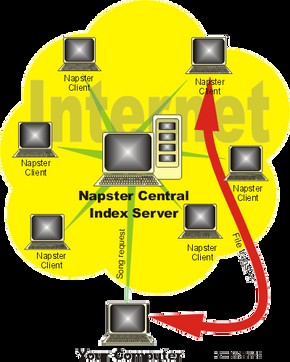
When you searched for a song, the process was a dance between your machine and a central index.
- You launched the utility.
- It checked for connectivity.
- It logged onto a central server. Note the distinction: the server held no MP3 files. It only indexed users. It tracked who was online and what files they had shared.
- You typed an artist or title.
- Your client queried the index server. It asked, “Who has this?”
- The server replied with a list of IP addresses where the file resided.
- Napster populated your results window with these sources.
- You clicked Download.
- Your computer established a direct connection with the host machine.
- The file transferred.
- The host disconnected.
- You played the track.
This architecture is why P2P was so efficient. It didn’t strain a central bottleneck. It distributed the load across the network itself. Sites like Gnutella later expanded on this decentralized model.
The Piracy Paradox
The music industry didn’t hate Napster because it was technical. They hated it because it was efficient at theft. Thousands of users were making thousands of copies of copyrighted material. No money changed hands. Artists saw zero revenue.
This sparked intense emotion. Fans loved it. Why pay $15 for a CD when they could get the track for free? The industry saw this as cannibalization. Napster’s legal defense was thin but distinct: they weren’t storing the files. The users were. Therefore, Napster claimed it wasn’t responsible for what users uploaded to their own machines.
Individuals don’t think about copyright law like corporations do. If you encode a song to MP3 and share it, anyone can grab it. It’s that simple.
The College Campus Effect
Napster was banned on about 40 percent of U.S. college campuses when it operated in its illegal phase. Yet, students were among its biggest users. Why?
- They liked music.
- Universities provided high-speed internet and computers.
- They were comfortable with new tech like MP3s.
- They were broke.
Low cost, high speed, and high interest created the perfect storm. Free music wasn’t just appealing. It was accessible.
Legal download sites operate differently. They cannot store or distribute copyrighted material without permission. That’s infringement. Even MP3.com got sued. They paid royalties, but they made copyrighted materials available for purchase without explicit permission from all holders. The legal line is thin.
Legally sourced songs come from:
- The public domain.
- Artists seeking exposure.
- Labels building hype for a new CD.
- Paid downloads where the site pays royalties to artists and labels.
The Legal Gray Area
The controversy deepened with the Audio Home Recording Act of 1992. This law allows CD buyers to make copies for personal use. It also allows them to give copies to friends. The catch: you can’t sell them or profit from them.
Napster fans argued this made their actions legal. The law didn’t specify who the friends were. It didn’t limit the number of friends. If I give you a copy, and you give it to three others, is that still personal? The law was silent on the scale. This ambiguity fueled the debate. It wasn’t just about technology. It was about how old laws fit new realities.
The system worked. The files moved. The rules didn’t.
The legal battles may have taken Napster out of the picture, but the underlying technology didn’t go anywhere. Peer-to-peer (P2P) file sharing is here to stay. It’s evolved past the initial MP3-only focus of early networks. Now, you can share virtually any file type.
Gnutella is a prime example. It removed the central index server that made Napster vulnerable. Instead of one boss server holding the map of all files, Gnutella uses a decentralized mesh.
How Decentralized Search Works
This architecture is why these networks are hard to kill. When a Gnutella client connects, it announces its presence to another node. That node shares the new connection with eight other peers it already knows. Those eight tell seven more. Those seven tell six. The network grows exponentially.
Each client now knows who is online and what files are available. There is no single point of failure. No central database to subpoena. No easy target for a shutdown order.
Content creators in music and video are starting to see the writing on the wall. They realize that royalty models need a fundamental overhaul. The old licensing structures don’t fit the internet’s revolutionary scale.
Napster’s Business Model
People often ask how Napster made money. The answer is surprising. It didn’t.
Shawn Fanning didn’t build it as a revenue-generating business. He built it to see if it could be done. He had no idea how massive it would become. The inventor wasn’t looking for a payout. He was looking for a proof of concept.
Frequently Asked Questions
Why was Napster shut down?
Napster was shut down due to copyright infringement. The central server model allowed rights holders to target the single point of control.
Did Shawn Fanning go to jail?
No. Since he was a minor at the time, he was sentenced to community service instead of prison time.
More Resources
- How File Sharing Works
- How MP3 Files Work
- How MP3 Players Work
- How Music Royalties Work
- How Music Licensing Works
- How CD Burners Work
- How MusicTellers Will Work
External Links
- Napster.com
- FindLaw: NAPSTER Lawsuit
- Salon.com: Send lawyers, guns and money – Nov. 6, 2003
- WiredNews: Uncovering the Napster Kitty Ads – Sept. 22, 2003
- WiredNews: The Day the Napster Died – May 15, 2002
- CNN.com: Some major universities reject ban on Napster – Sept. 22, 2000