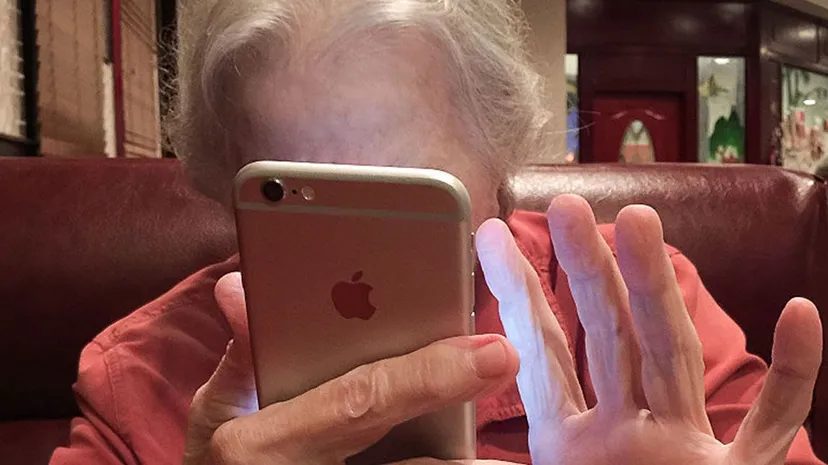
It took my 69-year-old mother years to finally give in. Her objections were classic. The phones cost too much. Plus, who did she have to text anyway? None of her friends were texting. Then, about two years ago, she picked up a second-hand iPhone. She has not put it down since.
She calls Word Crack her “drug of choice.” It is a Boggle-style word game that eats up hours. But she also uses that tiny screen for serious reading. She borrows books from the library digitally. One a day. Every day. And of course, there is FaceTime with the grandkids.
My mother-in-law is in the same boat. She knows the weather in every town where her seven children live. She checks the app compulsively. Then there are the notifications. Facebook. Instagram. GroupMe. Ding. Ding. Ding.
Millennials get the blame for smartphone addiction. Not seniors. My mom does ask for the senior discount at the movies. That is on her. But as more gray-haired Americans buy and use smartphones, are they becoming just as dependent on their digital devices?
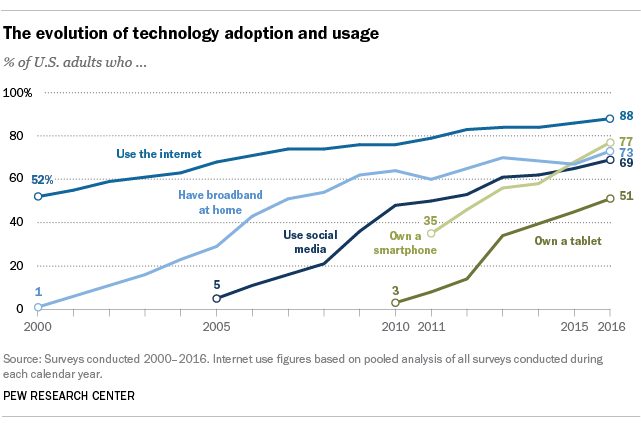
In January 2017, the Pew Research Center released data on smartphone adoption in the United States. Seventy-seven percent of American adults now own a smartphone. The fastest-growing demographic is people over 50. Seventy-four percent of them own a device.
That is up 16 percentage points from just two years ago.
For Americans 65 and older, ownership hit 42 percent today. That is a 12-point jump from 2015.
The Great Adoption Shift
The numbers show a clear trend. Older adults are catching up to younger generations. They are not just buying the devices. They are using them heavily.
Word Crack keeps my mother busy. The library app keeps her mind sharp. FaceTime keeps her connected to family. My mother-in-law uses the weather app to feel linked to her scattered children and grandchildren.
Social media plays a role too. The constant stream of alerts creates a loop of engagement. It is easy to see why someone might get hooked.
But is this addiction? Or just a new normal?
The data suggests the latter. More seniors are online. They are doing more things online. They are using their phones for more than calling. They are gaming. Reading. Connecting.
The gap is closing. Fast.
Why It Matters for Tech Users
This shift changes how we think about technology. It is no longer just a young person’s game. Seniors are adopting these tools at an unprecedented rate.
For tech writers and developers, this means designing for a broader audience. Accessibility matters. Simplicity matters. But so does engagement.
Seniors are not passive users. They are active participants. They have preferences. They have routines. They have dependencies.
Understanding this helps us build better products. It helps us understand our own habits. We all scroll. We all check. We all play word games.
Age is just a number. The addiction to connectivity is universal.
The Future of Senior Tech
Where does this go from here? Ownership will likely keep rising. Usage patterns will evolve.
Seniors are not going back to landlines. They are not returning to paper books. They are

Monica Anderson noticed the shift early. Back in 2015, Pew Research asked Americans to describe their relationship with their smartphones. Seniors gave overwhelmingly positive answers. They saw their devices as bridges to loved ones. Not distractions. Not boredom killers.
“Older Americans were more likely to describe their phone as something that connected them to other people as opposed to it being a distraction,” Anderson says.
She is a research associate at Pew. She helped analyze that survey data. It painted a hopeful picture. A healthier digital adoption curve for the elderly.
That was 2015. Now? Smartphone adoption among Baby Boomers and seniors has spiked. The hardware is everywhere. The question remains whether older users will pick up the bad habits of text-obsessed teens and social-media-enslaved millennials.
The slot machine in your pocket
Dr. David Greenfield is not optimistic about the “healthy” narrative. He founded the Center for Internet and Technology Addiction. He is an assistant clinical professor of psychiatry at the University of Connecticut School of Medicine.
He wrote “Virtual Addiction” in 1999. It was prescient. He is a leading expert on internet and gaming addiction. His conclusion? Older Americans are just as susceptible to the neurological traps of addictive behavior.
“I have many patients who are in their late 50s and 60s, and a few older,” Greenfield says. “Based on [the Pew] statistics, it’s likely that you’ll see more people get into trouble with it. But I don’t think you’ll see the numbers become equivalent to the millennials.”
There is a difference in how they get hooked. The older patients in Greenfield’s clinic tend to use unrestricted smartphone access to feed offline addictions. Shopping. Gambling. Stock trading. Pornography.
Younger patients? They struggle with social media and gaming. These have no direct offline equivalents. The dopamine hit is purely digital.
Still, the device itself is the problem. It is designed to push buttons in the brain. Compulsive behavior follows. Addiction in people of all ages.
“The smartphone is the world’s smallest slot machine,” Greenfield says.
Think about it. Every time you go online, you don’t know what you will find. Will there be a social media update? A deal on shoes? Your sports score? A stock price drop? An email?
Your brain releases a pleasurable shot of dopamine when it finds something novel and exciting. Every notification “ding” is a green light. It signals a potential dopamine boost. It is like waiting to see if that third cherry falls into place on a slot machine.
“That’s why people check their phones a hundred times a day,” Greenfield says. “It’s incredibly addictive. Incredibly addictive.”
Not enough data yet
Both Greenfield and Anderson agree on one thing. We lack sufficient data. We cannot say with certainty that older Americans are anywhere near 20-somethings in their level of smartphone use.
Pew is currently working on a follow-up survey. It will focus specifically on seniors and mobile technology. Until then, we are guessing.
It is tempting to dismiss this as a harmless compulsion. Annoying, yes. Harmless? Maybe.
What if grandma checks her Facebook feed during dinner? Your teenager has been doing it for years. Nobody dies from a slightly cold casserole.
But there are situations where the compulsive need to check your phone turns deadly.
Distracted driving.
The cost of distraction
In 2014, 3,179 people were killed in accidents caused by distracted driving. 431,000 were injured.
Statistics show young people are far more likely to text or email while driving. They are not the only ones.
A 2012 survey by the National Highway Traffic Safety Administration found that 2.2 percent of people 65 and older who were in a crash reported reading a text or email at the time.
For 18- to 20-year-olds, that number was 3.3 percent. But as many as 8.2 percent were sending a text when they got into a crash.
Why do young people engage in this risky behavior? Their prefrontal cortex is not fully developed. That is the part of the brain responsible for judgment and using past experiences to make decisions. It doesn’t mature until the mid-twenties.
“Almost everybody uses their smartphone while they drive in ways that are risky, even though they know it’s dangerous,” Greenfield says. “We see the same behavior in adults and older adults who have the neurological capacity to make good executive decisions.”
Here is the kicker. Older people generally have slower reflexes. Slower response times than youngsters.
Add that to the equation. You have a growing problem.
Attention spans shrink
According to a 2015 report from Microsoft Canada, the attention span of an average human adult dropped to eight seconds in 2013. It was 12 seconds in 2000.
A goldfish has a nine-second attention span.
Sure. But goldfish can’t even hold a smartphone.