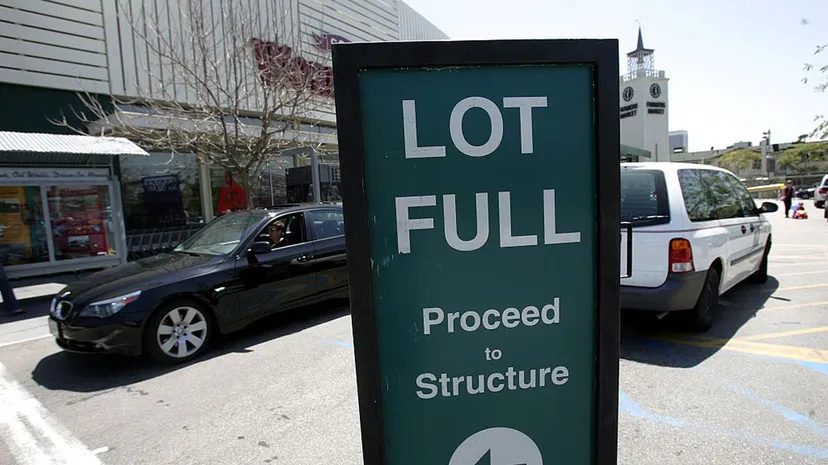
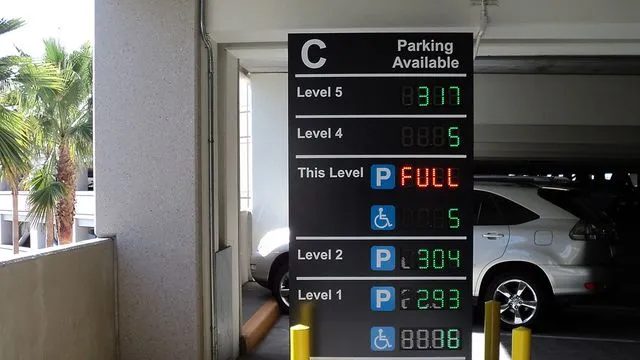
You’re late. 45 minutes to takeoff. You’re tearing into the airport parking garage, praying for a miracle. The digital signs above the entrance lie to you—or at least, they mislead you. They say seven spots are open on the roof. You gun it. You break the 5 mph speed limit. You screech up the ramps, heart pounding, only to find motorcycles, compact-only zones, and angry drivers honking at your empty “spot.”
Welcome to parking garage hell.
It’s a frustrating loop. You trust the system. The system says go. You go. You arrive. Nothing is there.
More garages are installing automated car-counting systems. You’d think technology solves this. It doesn’t always. In fact, in the busiest lots, these systems often fail the people who need them most. They tease you with availability, lead you down a dead end, and force a humiliating retreat.
Why does this happen? How do these counters actually work? And why do they lie?
We talked to Dale Fowler. He’s the company director for Indect USA. His firm installs advanced parking guidance systems. Airports, hospitals, malls, casinos. They build the brains behind the green lights.
Indect’s main product is a single-space sensor system. It’s expensive. It’s precise. And it’s rare.
How single-space parking sensors actually work
Most garages use loop detectors or cameras at the entrance. They count cars going in and out. This is basic math. In minus out equals available.
This method fails fast.
What if a car stalls in an aisle? The system still thinks the spot is taken. What if a motorcycle parks in a full-size spot? The camera sees a car-sized gap. The system marks it open. It’s not.
Indect fixes this with granularity. They mount a sensor over every single parking spot. Not just the aisle. The specific rectangle of asphalt.
“Our bread and butter is a single-space system that mounts a sensor over every single parking spot.”
The sensor detects presence. If the spot is clear, a green LED light turns on. Bright. Visible. Unambiguous.
If the spot is taken, the light stays dark or turns red.
This eliminates guesswork. You don’t hunt. You follow the green lights.
But there’s a catch. Cost.
Why most airports don’t use green light systems
The Indect system costs between $300 and $500 per parking space. That’s before labor.
Do the math.
A small lot with 500 spaces costs $150,000 to $250,000 just in hardware. A massive facility like Dubai Mall? They have 15,000 spaces. That’s $4.5 million to $7.5 million in sensors.
Most cities and airport authorities don’t have that budget. Or they don’t see the ROI.
So they stick with the cheap counters. The ones that fail when you need them most.
Where do you see the expensive stuff?
Indect has installed their systems in high-profile locations. Beverly Hills. Colorado State University. John Wayne Airport. Dallas/Fort Worth International Airport.
These are places where time is money. Or where real estate is too expensive to waste circling.
But even there, the technology isn’t magic. It’s engineering. And like all engineering, it requires maintenance. A sensor can break. A lens can get dirty. A wire can cut.
When a single sensor fails, the whole map lies.
You trust the data. The
Why your parking garage lie to you about empty spots
Old garages rely on induction loops. Coils of wire cemented into the asphalt. They’ve been around for 50 years. They work like a beach metal detector. Car passes over. Metal disturbs the electrical field. The loop says beep. One car. Or maybe two. Or none. It’s prone to errors.
Modern systems use ultrasonic sensors. One per space. Fowler says they are 99.9% accurate. So when the sign says seven spots, there are seven spots. Induction loops? Not so much. They struggle with tailgating. Cars bunch up. Three vehicles look like one to the sensor.
The math is brutal. A single sensor is 99% accurate. Fine. But a car triggers 8 to 10 sensors as it drives through. Multiply those small error rates. The total accuracy drops to 90%. In a busy garage, that’s a lot of wrong numbers. You drive up. Sign says full. You wait. You leave. The spot was open. Or the sign says open. You drive in. It’s full.
You can’t tell the tech from the street. Is it Indect’s single-space sensors? RedStorm from Signal-Tech using infrared? Or just old wire loops? Hard to say. So trust the “spaces available” sign with a heavy grain of salt. Leave earlier for the airport. Seriously.
Where is the largest parking lot in the world
West Edmonton Mall holds the title. Alberta, Canada. The main lot has 20,000 spaces. That’s a lot of asphalt. Overflow lots add another 10,000. Thirty thousand cars total. Guinness World Records confirmed it.
Most of us don’t park there. We park in the old loop systems. The inaccurate ones. The ones where three cars become one. Next time you see a discrepancy, blame the physics. And the age of the garage.