Digital Dubai has launched a strategic AI Integration Matrix Framework, a new blueprint designed to transition government entities from isolated, fragmented AI experiments toward a cohesive, city-wide AI ecosystem.
Released this week via a comprehensive whitepaper, the framework provides a structured methodology for classifying, prioritizing, and scaling artificial intelligence across all levels of public administration.
The Four Quadrants of AI Deployment
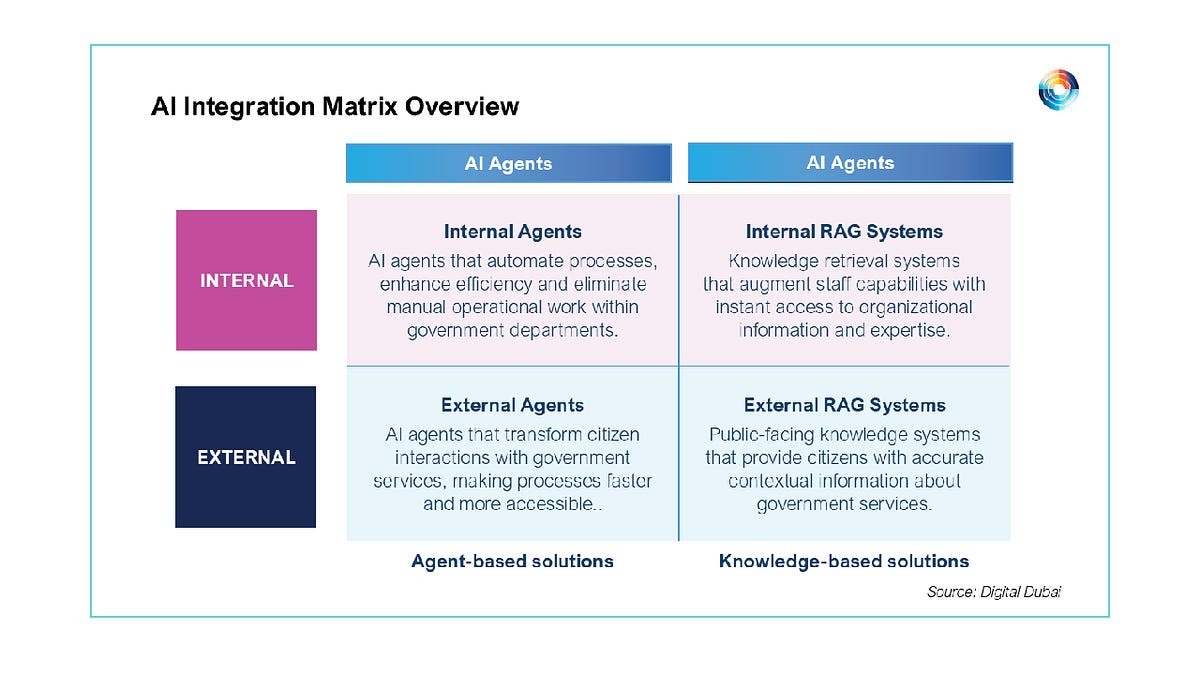
The core of the framework lies in its ability to categorize AI use cases into four distinct quadrants. By organizing technology based on its function (Agents vs. RAG systems) and its audience (Internal vs. External), the matrix allows leaders to see exactly where their investments are going.
The four pillars of the matrix are:
- Internal Agents: AI tools designed to automate back-office operations and streamline staff workflows.
- Internal RAG (Retrieval-Augmented Generation) Systems: Specialized systems that provide employees with instant, accurate access to institutional knowledge and government policies.
- External Agents: Autonomous tools that handle public service delivery and automate transactions for citizens.
- External RAG Systems: Public-facing interfaces that offer real-time information and personalized guidance to the community.
Solving the “Pilot Trap”
In many modern governments, AI implementation suffers from the “pilot trap”—a trend where individual departments launch successful small-scale projects that never communicate with one another. While these pilots show promise, they often fail to create systemic change and can lead to redundant spending and data silos.
Digital Dubai’s framework addresses this by providing a shared language for all government entities. This ensures that:
– Investment is prioritized: Resources are directed toward high-impact areas rather than redundant tools.
– Coordination is seamless: Different departments can build systems that work together rather than in isolation.
– Scalability is built-in: The framework moves beyond “testing” AI to “embedding” it into the very fabric of government operations.
The methodology is not merely theoretical; it has already been battle-tested. Digital Dubai has utilized the matrix to guide the deployment of over 100 AI systems across various sectors, proving its efficacy in a live, high-stakes environment.
The Foundation: Data and Governance
The whitepaper emphasizes that sophisticated AI models are useless without a solid foundation. For the matrix to function, government entities must prioritize:
– Data Quality: Ensuring information is accurate, reliable, and well-managed.
– Governance: Adhering to strict ethical and regulatory frameworks to maintain public trust.
– Strategic Sequencing: Using gap analysis to decide which AI initiatives should be launched first based on available resources and strategic goals.
A Global Benchmark for AI Governance
This move is part of a broader, multi-year momentum in Dubai to become a global leader in AI integration. Since 2023, the emirate has built a massive institutional architecture for AI, including:
– The creation of the Dubai Centre for Artificial Intelligence.
– The launch of the Dubai Universal Blueprint for AI.
– The appointment of 22 Chief AI Officers across government departments.
– The formation of the Dubai AI Acceleration Taskforce.
By providing this framework, Dubai is not just organizing its own government; it is creating an exportable model of AI governance that other nations can adapt to their own contexts.
The AI Integration Matrix marks a shift from simply “adopting” AI to “embedding” it, transforming the government into a single, interconnected system centered around the needs of its people.
Conclusion: By moving away from isolated AI pilots and toward a structured, four-quadrant integration model, Digital Dubai is establishing a scalable roadmap for how modern governments can use artificial intelligence to drive systemic efficiency and citizen-centric service.