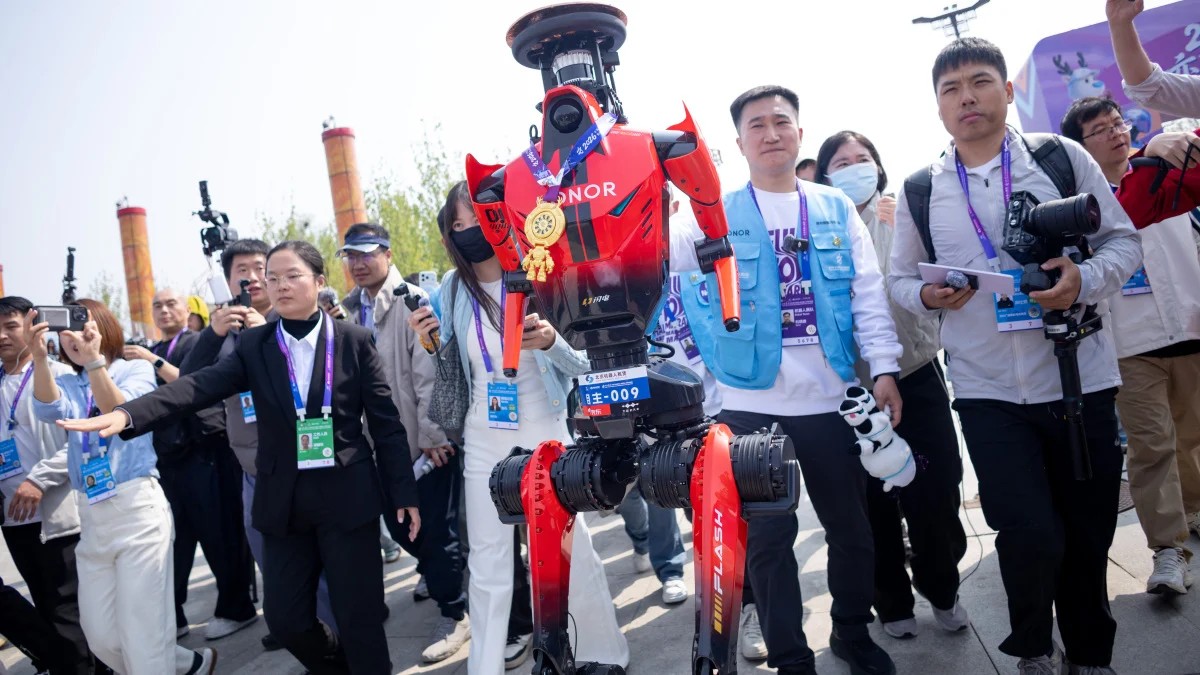
In a remarkable demonstration of rapid technological evolution, a humanoid robot has officially broken the world half-marathon record. The winner, a bright red autonomous robot nicknamed “Lightning,” secured first place at a specialized race in Beijing, China, outperforming even the fastest human competitors.
The Race: Man vs. Machine
The event was part of an annual “robot versus human” half-marathon held in Beijing, a competition designed to pit the latest advancements in robotics against human endurance. While the race featured various models, Lightning’s performance was unprecedented.
The robot completed the course in 50 minutes and 26 seconds. To put this achievement in perspective:
– It was six minutes faster than the fastest human runner.
– It improved its own time by nearly two hours compared to its performance in last year’s race.
Engineering the “Athlete”
The robot was developed by Honor, a Chinese firm known for smartphones and robotics. To achieve such high-speed performance, engineers moved beyond mere mechanical walking and began modeling the robot after elite human athletes.
Key technical upgrades that contributed to Lightning’s speed include:
– Biomimetic Design: The use of elongated legs to maximize stride efficiency.
– Thermal Management: An internal liquid-cooling system designed to handle the intense heat generated by high-speed movement.
– Enhanced Stability: Improvements in balance to prevent the frequent tumbling often seen in two-legged autonomous machines.
The Broader Context: A Global Robotics Race
This milestone is more than just a sporting feat; it serves as a signal of the intensifying technological competition between China and the United States. Over the last several years, Chinese robotics companies have significantly accelerated their development cycles, aiming to lead the world in humanoid automation. Lightning’s success suggests that heavy investment in AI-powered humanoid models is yielding tangible, high-performance results.
However, the technology is not yet fully autonomous or perfected. The race revealed several remaining hurdles for the industry:
– Operational Dependency: Approximately 60% of the competing robots required remote assistance from human teams to finish.
– Mechanical Reliability: Many bots struggled with stability, experiencing stumbles at the starting line or falling during the race.
Conclusion
While the industry still grapples with issues of stability and full autonomy, Lightning’s record-breaking sprint marks a turning point where humanoid robots are transitioning from novelty performers into highly efficient, specialized machines.