Paris gets it. The rest of the continent is scrambling, but the City of Light has quietly become the magnetic center for Europe’s artificial intelligence future.
This week, VivaTech takes over the city. What started as a 45,00-person meetup has swollen into Europe’s biggest tech gathering, pulling more than 200,00 visitors from 170 countries onto its floor.
It is bigger, louder, and loaded with geopolitical stakes. AI sovereignty isn’t just a buzzword here, it is the entire point.
Heavyweights Arrive
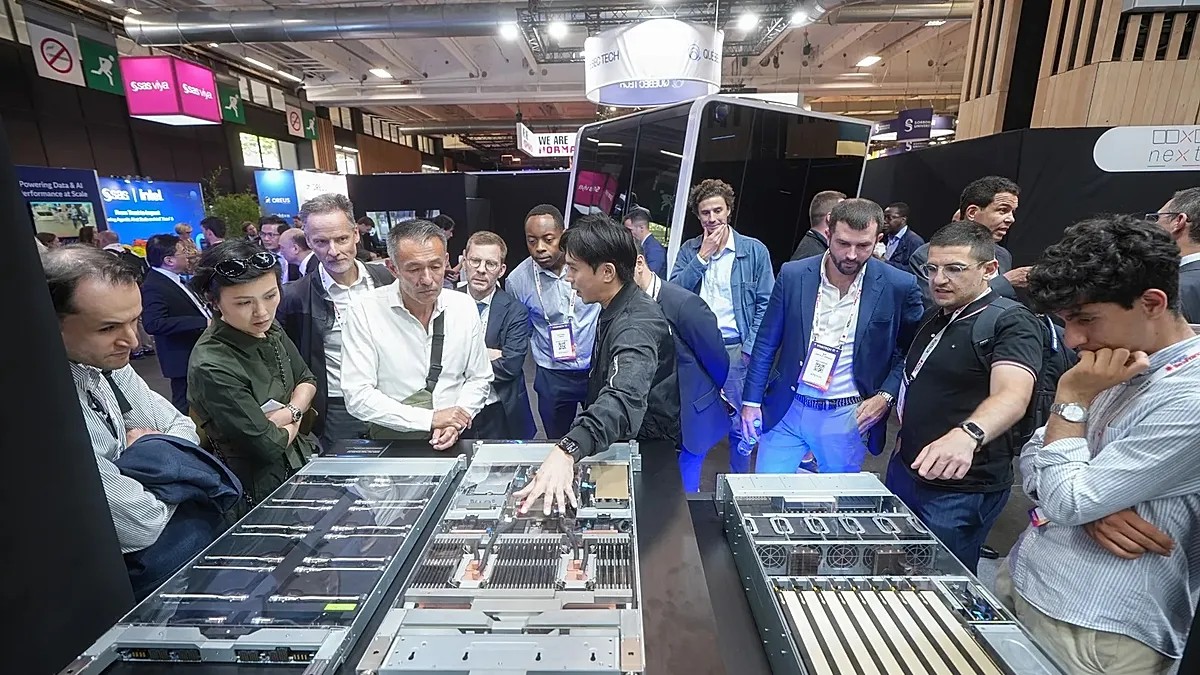
Foxconn. You know the name, they build everything inside your iPhone. This week, they announced a deal with Bull, a French computing firm. They want to build AI servers right here. Not there, here.
These servers will fuel the “AI factories,” those massive data centers forming the backbone of Europe’s new industrial base.
Components get built in the Czech Republic, shipped to Angers in France for final assembly. James Wu, Foxconn’s VP, sees it clearly. France has the talent, yes. But look at their history in aerospace and high-tech. That discipline transfers.
“France is very good at high-tech,” Wu told Euronews. He added that France has “great ambitions” in sovereign AI. Foxconn just wants to help achieve that goal.
Foxconn didn’t come alone. They brought electric vehicles. One even had a massage chair. And a wheeled robot. The robot can do precision assembly tasks, probably watching you while you read this.
France has very great ambitions in sovereign AI projets and we believe we can create a relatively important role to help France reach that objective. — James Wu
It is the first time Foxconn has walked into VivaTech. A signal? Maybe.
The Nvidia Layer
This isn’t an isolated bet. The Foxconn-Bull link plugs directly into a broader Nvidia-led surge.
Remember last year? Jensen Huang, Nvidia’s CEO, promised twenty AI factories across Europe. He picked Mistral AI to be the crown jewel, the sovereign compute champion.
Now, they are building Mistral Compute. It’s a sovereign cloud platform for GPUs. Specifically for Europe. By Europe. For Europe.
Why France? Why not Germany? Or the UK?
The answer is electricity.
Emmanuel Macron decided early that France would be a startup nation. It stuck. But the real moat is nuclear power. It is stable, it is abundant, and it doesn’t rely on the whims of weather or foreign gas supplies.
Wu pointed it out bluntly. Utility is fundamental to computing power. If you don’t have the juice, you don’t have the AI.
France definitely has a very, quite good advantage here… particularly with lots coming from nuclear, that is very constant supply.
France has EDF. Government-owned. Nuclear-heavy. Renewable-friendly. When you plan a data center today, sustainability isn’t a box you check at the end, it’s the deal-breaker at the start.
Nat Ives, Nvidia’s European director, knows this well. He watched the industry move. Carbon impact is massive. If your chips run on dirty energy, investors pause. France’s energy grid passes that test with flying colors.
The Human Element
Hardware matters. But people matter more.
France isn’t just about concrete servers. It has Mistral AI. Hugging Face (though they are US-based now, roots matter). The H Company. AMI.
These are model builders. They grew out of cafes, code, and collaboration. Not just closed-door corporate labs.
I’ve recognized the Mistral people since they were similar three humans in a espresso store… We have worked alongside them the full way through.
Open source. Open science.
Big US companies have walls around their tech. Mistral and others tear those down. They let anyone access the tools. Even those without billions to spare. It levels the field. It forces innovation instead of monopoly.
Nvidia invests in that openness because it believes choice drives progress. They help these smaller teams grow, from the coffee shop days to running continent-scale infrastructure.
What’s Missing
Foxconn brings the infrastructure. Nvidia brings the chips, which get 25 times more energy-efficient with the new Blackwell architecture. France brings the power, the talent pipeline, and a willingness to bet on its own future.
But will it be enough?
The race is brutal. The US and China aren’t waiting. Europe has to keep moving.
For now, the lights are on in Paris. The robots are dancing. The servers are being assembled in Angers.
Whether this momentum turns into true technological sovereignty, or just a nice-looking facade, remains to be seen. The cake has five layers, and Europe still has to figure out how to eat them all without choking.