


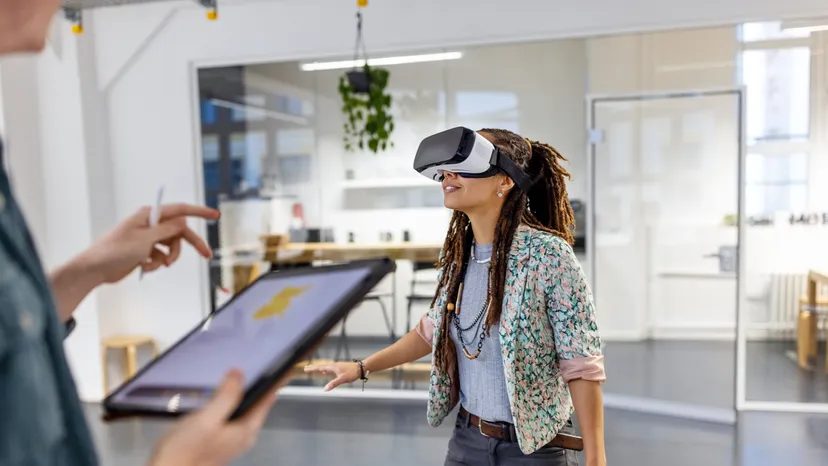
Virtual reality has remained on the sidelines of the technology world for decades. It never became mainstream. Sales were slow. Adoption is a niche market. But in 2016, Citigroup analyst Kota Ezawa declared that the tide was turning. He predicts that VR will eventually become accepted. The market is expected to reach $200 billion by 2019. This figure also includes hardware. It counts networks. It factors in software and content.
Such numbers attract not only players but also many people. The industry is changing. They don’t see VR as a toy, but as a tool for training and completing tasks. The headset is becoming a window to new ways of working. This is how this technology is used outside of gaming.
Film and engaging storytelling
Many consider movies to be the killer app for VR headsets. Oculus has already started hiring from Pixar. They are building a virtual reality movie studio. The goal is deep immersion. It’s not just about watching movies. You are inside it. The graphics and sound effects are attractive.
Traditional filmmaking techniques can often be confusing in VR. Animators and cinematographers had to invent new methods. They needed a new way to shoot. Transitioning between scenes requires new logic to maximize engagement. If Hollywood and independent filmmakers embrace VR wholeheartedly, the future of cinema is unpredictable.
Live events and stadiums
For sports fans, VR live events are a game changer. Companies like LiveLike and NextVR are leading the way. LiveLike builds virtual stadiums. It brings the thrill of game-day into your living room. NextVR has even bigger goals. They want to become the Netflix of virtual reality.
The company has released an app to stream the first game of the NBA season. It broadcast from the sidelines. After the demo, Comcast and Time Warner invested more than $30 million. NextVR plans to use VR for events such as Cirque du Soleil and large concerts.
Museums and cultural heritage sites
You can spend an afternoon visiting the Louvre, the Metropolitan Museum of Art or the National Gallery. The museum cooperates with software developers. They create a virtual space to visit famous collections. The British Museum in London is hosting a virtual reality weekend event. At the American Museum of Natural History in New York, you can browse the collection via Google Cardboard. Anyone with a smartphone and a Cardboard headset can watch it.
Courtrooms and 3D Evidence
For decades, judges and juries have relied on grainy, two-dimensional photographs. They use them to identify individuals. The depth of the crime scene assessment is limited. Viewing crimes in 3D allows for complete visualization. Shows how events occur over time in a specific space.
In 2014, researchers from the University of Zurich published an article. They examined using the Oculus Rift to reconstruct trial scenarios with the Oculus Rift. Their findings were clear. Interactive technology, such as a VR headset, makes it easier to understand the details of the case. Jurors could make more informed decisions about a person’s innocence or guilt.
Military training and simulation
The US military has been using VR simulators for many years. It trains soldiers for deployment. They use a special non-commercial developer platforms. Troops participate in a game-like combat simulation. They practice doing things together. They use tactical equipment in an accurately reproduced 3D environment. The engaging aspect is very important. It captures full attention. Learned skills are easier to retain and remember. The gap between high-end military VR equipment and consumer equipment is closing fast.
Hidden uses of #VR: Beyond games and headaches
Tourism and healthcare are the most practical industries for implementing VR. But the real story isn’t about escapism. It’s about reducing risk. and cost savings.
The gap between tourism and decision-making
Travelers are overwhelmed. The options are endless. Details are vague.
Phocuswright’s analysts do not see VR as new, but as a decision-making tool. The value proposition is simple. Show the user the resort. Let them go for a walk on the beach. See the room view.
In this way, destinations that do not have world-famous landmarks can compete. Virtual tours fill the gap between the brochure and reality.
Matoke Tours was the first to act. In early 2016, they launched an app focused on Ugandan tourist attractions. Let’s go flying with a hot air balloon. Encounters with wild animals. All 360 video. This is a virtual brochure.
Ascape followed. Free for iPhone. Trips to Berlin, San Francisco and Botswana.
Hotels are also involved when Marriott launched the VRoom service last September. Guests borrow a headset. They are visiting Beijing. Chile. Rwanda.
It’s not just about making a reservation. It’s about pre-experiencing the stay.
Meditation and phobia treatment
Stress is your enemy. VR offers an escape hatch.
Guided Meditation VR allows users to wear Oculus headsets. A cozy environment replaces the office. The brain uses vision and hearing as the main inputs. False sensory information tricks your brain into believing you are somewhere else.
it works.
But there is also a clinical side. VR creates a safe environment for exposure therapy.
In 2014, veterans with post-traumatic stress disorder (PTSD) faced their fears The results were published in the American Journal of Psychiatry. VR exposure therapy is effective.
Controlled fear. Real relief.
Healthcare: Simulation and rehabilitation
Healthcare providers don’t wait for consumer hype. They were early adopters of VR.
Why? risk.
Surgeons need training. Patients cannot be used as guinea pigs.
Surgical Theater and Conquer Mobile created the simulation using real CAT scan and ultrasound data. The result? Detailed 3D anatomical models.
The surgeon can locate the tumor. Plan incisions. Test approaches. All without touching the patient.
Rehabilitation is another frontier.
MindMaze in Europe treats brain injury patients. This therapy mimics a video game. Real-time feedback can increase patient motivation. Motor and cognitive functions recover faster than with traditional physiotherapy.
It’s fascinating. It’s effective. This is medical.
Automotive Manufacturing: Testing Before Tooling
Car companies spend money on research and development.
Prototypes are expensive. Recalls are devastating.
Ford’s Immersion Lab in Dearborn, Michigan solves this problem. Engineers put on VR headsets. They inspect every inch of the car before it actually exists.
This technology is integrated with Autodesk’s CAD system. Engineers carefully inspect the engine. dashboard. Fits inside.
Potential issues are spotted early. Complications become data points. Costly recalls become avoided headlines.
It’s not just design. This is financial defense.
Space Exploration and Control
NASA uses VR for training. And for control.
At CES, attendees boarded the Orion capsule. Scheduled for 2018. The simulation shows the responsibilities of an astronaut. Realistic preparation.
But the tech goes further.
Researchers at NASA’s Jet Propulsion Laboratory connected the Oculus Rift to the Xbox One Kinect 2 sensor. Motion detector hardware. The result? A method to control robotic arms via human gestures.
Think about the implications. Manipulating rovers millions of miles away. Use human intuition in situations where real-time control is not possible due to delays.
The Virtuix Omni treadmill and VR headset help astronauts prepare for landing on the surface of Mars. The simulation was advanced. The stakes are infinite.
VR is more than just a toy. It’s a tool for high-stakes environments. Mistakes can cost millions of dollars. Or life.
The next wave has nothing to do with entertainment. It’s a matter of accuracy.
How virtual stores are changing online shopping
Trillenium wants to remove static product pages. The startup builds virtual stores for brands with the aim of recreating the brick-and-mortar boom in the comfort of your own home. It’s more than just scrolling a flat image. The user moves to a real-time environment. You can invite friends to a meeting. The social layer changes everything.
The British fashion and beauty giant ASOS is already testing the waters. Shoppers don’t just click. They look around. Focusing on an item reveals details. Rotating products gives a true sense of scale. It feels less like browsing and more like wandering an aisle. Mintel predicts that UK e-commerce sales will reach £71.2 billion by 2020. That’s a 64 percent jump. The infrastructure is there. The demand is waiting.
VR in the classroom: beyond the textbook
Google took a different approach in 2015. Google’s Expeditions Pioneer program isn’t designed to sell you anything. It was about seeing everything. The schools received packages containing Asus smartphones and teachers’ tablets. With a local router, you won’t experience network delays when traveling. The library held over 100 trips. The Eiffel Tower. The Great Wall of China. Everything is in the palm of your hand.
Other platforms are also stepping up their efforts. LectureVR and AltspaceVR allow educators to create avatars. They run multiplayer sessions. Interaction spikes. Socialization becomes part of the curriculum. This is no longer passive learning.
Toyota sees potential in safety training. The TeenDrive365 campaign uses Oculus headsets to teach teenagers and parents about distracted driving. The immersive nature of VR makes consequences feel real. This is not a lecture. It’s an experience. If it works in driving, why should it work in other areas of education?
Change is happening. Retailers are building the stores. Schools are building the classrooms. The technology is no longer a novelty. It’s becoming the floor.


