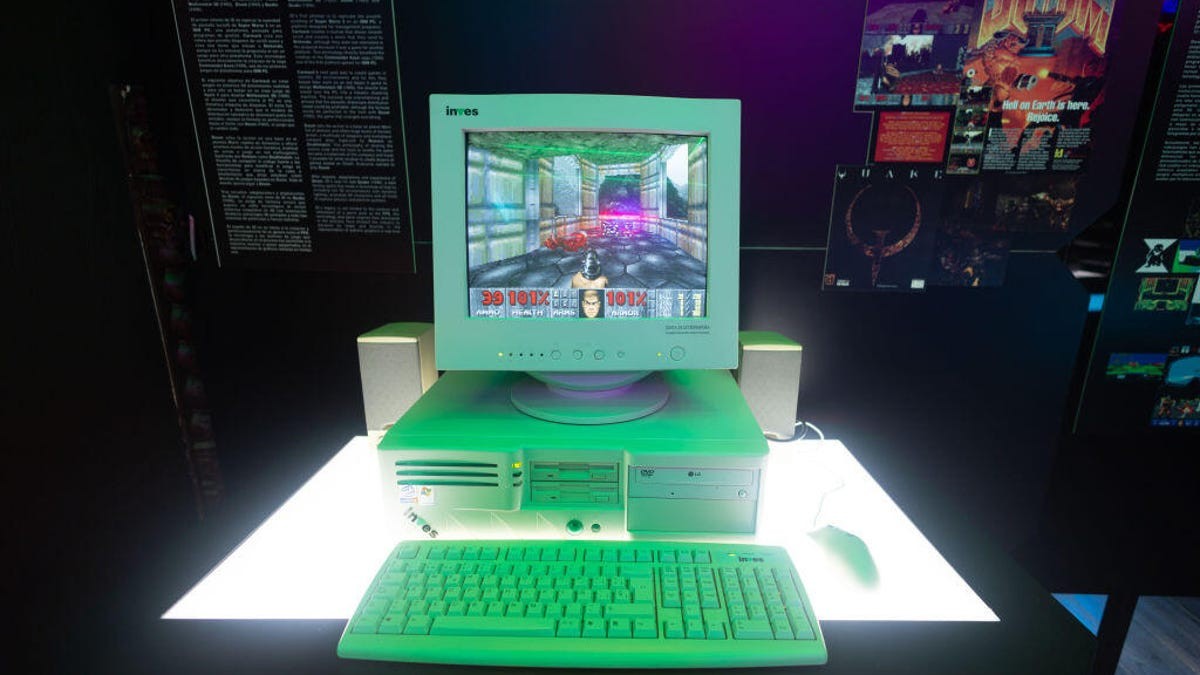
Doom is old. 1993 old. It launched when grunge was taking over the charts and Y2K was still a theoretical doomsday clock ticking down. Yet, the demon-slayer hasn’t just survived. It has multiplied. You’ve probably seen it on hardware that was never meant to host a video game. Smart fridges. Graphing calculators. Maybe even that air fryer sitting on your counter.
Why this specific 32-bit shooter? It’s not magic. It’s code. Specifically, the fact that how to run Doom on weird hardware has become a cultural rite of passage for engineers, tinkerers, and bored teenagers alike.
This isn’t about nostalgia alone. It’s about accessibility. The original source code was open. That opened a floodgate of possibilities, turning a linear FPS into a benchmark for “can it run?”
The Myth of the Official Ports
Let’s get one thing straight: Doom was always a chameleon. Id Software built it on a NeXTcube, sure, but its home was the IBM PC. Before most developers were even thinking about cross-platform compatibility, Doom was already living rent-free on OS/2, Linux, Solaris, and early Windows machines.
Console gamers got their turn too. Super Nintendo, Sega Saturn, original PlayStation. You can play it on an Xbox Series X right now. It feels effortless today, but back in the 90s, getting a high-fidelity 3D engine to work on limited console architecture was a nightmare.
That accessibility kept the game alive for new generations. You didn’t need to dig through estate sale boxes to find an old Commodore 64 or hunt for MS-DOS 6.22. But the official story is boring. The interesting part starts when people ignore the rulebook.
“I wrote a complete set of tools… before I could even start on the actual game.”
— Randy Linden, developer
That quote sums up the unofficial spirit. It wasn’t about convenience. It was about defiance.
Why the Super Nintendo Was the Spark
The legend didn’t start with AI-generated OSes or bacterial displays. It started with a 16-bit console that simply shouldn’t have had the chops. The Super Nintendo (SNES) lacked the raw power to run Doom natively. Most people said it was impossible.
Randy Linden from Sculptured Software disagreed. He knew he couldn’t do it with the SNES processor alone. He needed a co-processor. He found the SuperFX chip. This chip powered Star Fox, a 3D shooter, so technically, the hardware existed. But no dev kits existed for it.
So Linden hacked a Star Fox cartridge. He built an assembler, a linker, and a debugger from scratch. Then he built his own engine, calling it the “Reality Engine,” just to get Doom to render.
The results were rough. Five levels were cut. There were no floor or ceiling textures. Enemies were static sprites that only faced you—you couldn’t sneak up, you just blasted them from the front. It looked blocky. It played awkwardly. But it ran. And that moment, that can-do defiance, birthed the meme: If it has a screen, it can run Doom.
The Explosion of “Weird” Ports
From the SNES, things got ridiculous. The mid-2000s saw the peak of calculator hacking. If you took Computer Science in high school, you remember the TI-83 and TI-84 calculators. Students installed Doom to play during lectures. It was the original stealth gaming.
Since then, the floor fell out. What defines “hardware”?
Here are a few standout examples that break the internet’s sense of reality:
- Smart Appliances: Modern fridges are essentially Android phones with shelves. People installed Doom on smart refrigerators, air fryers, pressure cookers, and toasters. Because why not?
- Potatoes: Okay, technically the calculator was running it, but the power source was several hundred potatoes wired together. It references Portal 2’s Potato Gateway, proving that even biological electricity works if the circuit is right.
- Pregnancy Tests: A modder named Foone Turing gutted a standard test and replaced the internals with a tiny computer board. The screen displayed the gameplay. The result was a positive pregnancy… test. It was absurd. It was brilliant.
- Bacteria (E. coli): Lauren Ramlan, a Ph.D. student, used E. coli bacteria as pixels on a display. It was a biological computer. Doom ran on it. The catch? It runs at a few frames per day. Completing the game would take six centuries. You’ll be long dead, but the zombies will wait.
- Minecraft: Redstone is the game’s wiring logic. Players built functioning PCs inside Minecraft using Redstone gates. These virtual machines then ran the real Doom. It’s Doom playing itself. Meta enough.
- The MacBook Pro Touch Bar: That tiny OLED strip at the top of older MacBooks was too small for normal typing, but perfect for Doom’s resolution. It fit like a glove.
- PDF Files: A PDF in Chromium browsers (like Chrome or Edge) can run JavaScript. Hackers turned the document renderer into a game engine. The graphics were just text characters arranged in blocks. Still played.
Google even showed off this capability at their I/O conference this year. They used an AI model (Gemini) to vibe-code a new operating system from scratch. How did they prove it worked? They ran Doom. Because nothing says “my AI understands computing” like a pixelated shotgun.
Why Doom and Not Skyrim?
You might ask: Why don’t people do this with Call of Duty or FIFA?
It’s legal, mostly.
In 1997, Id Software did something radical for the time: they released the Doom source code. They made it freely available for non-commercial use. John Carmack, the legendary coder behind the game, essentially handed the world the blueprints.
On the GitHub page for the source, Carmack wrote that the code only natively compiles on Linux, but added:
“Port it to your favorite operating system.”
He gave permission to tinker. That green light is invaluable. Without that explicit permission, modifying copyrighted code is a lawsuit waiting to happen. With it? It’s a hobby.
Plus, Doom is light. Weighing in from the 90s when CPUs were measured in Megahertz, Doom’s requirements are laughable by today’s standards. Your smart thermostat likely has more raw power than a 1996 Pentium. The bottleneck isn’t processing power; it’s creativity.
Other games try to join the party, but Doom wins by default. Wolfenstein 3D and Quake are also Id Software open-source projects and appear on odd hardware occasionally, like iPods. Minecraft, being Java-based, gets ported often (even back into itself). Super Mario 64 had a big open-source moment too. Even Bethesda joked about putting Skyrim on fridges and Amazon Echoes.
But none of those have the same cultural shorthand. None of them mean “hack this.”
The Engine of the Meme
Doom stopped being a game and started being a utility. A test case. When engineers build something new—a volumetric display that looks like Star Trek, or a bio-computer out of E. coli—they don’t test it with Word or Excel. They test it with Doom.
It proves the hardware works. It proves the rendering pipeline is intact. It celebrates the absurdity of modern computing power.
We’re left with a weird legacy. We have devices that calculate heart rates, control thermostats, and diagnose pregnancies running a game about fighting hell-spawned monsters. It makes no logical sense. It makes perfect geek sense.
So where next? Maybe your smart toilet. Maybe your contact lenses. If there’s a processor in there, the demons are coming.