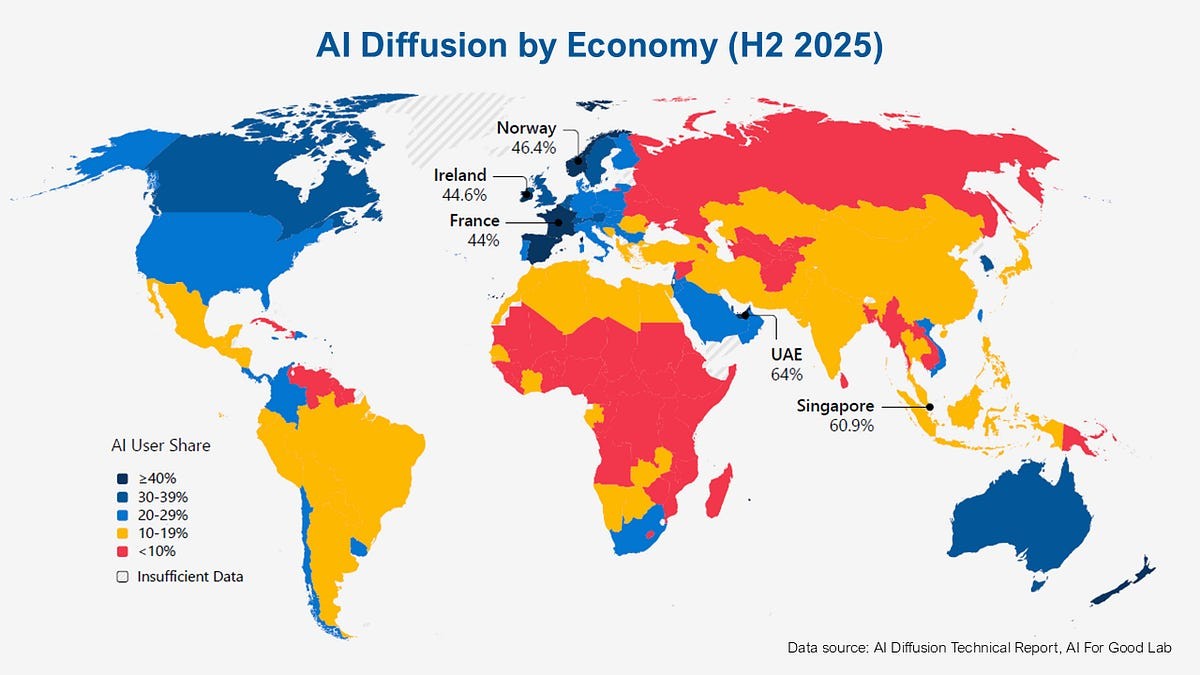
The United Arab Emirates (UAE) has cemented its position as the world leader in artificial intelligence (AI) adoption, with 64% of its working-age population now actively using generative AI tools as of late 2025. This figure, released by Microsoft’s AI Economy Institute (AIEI), represents a significant lead over second-place Singapore at 60.9%. The UAE’s success isn’t accidental – it’s the result of proactive government policies, strategic investment in infrastructure, and a focus on AI education dating back to 2017, years before generative AI became mainstream.
Early Government Leadership and Strategic Investment
The UAE’s approach to AI differs significantly from other nations. In October 2017, the country appointed the world’s first Minister of State for Artificial Intelligence, demonstrating a long-term commitment that predates the recent AI boom. This was followed by a national AI strategy targeting nine key sectors. The foresight is striking: the UAE recognized the potential of AI before the launch of tools like ChatGPT, establishing a foundation of trust and familiarity that enabled rapid adoption when consumer AI became widely available.
The country also prioritized AI education, launching initiatives like the UAE AI Summer Camp seven years ago. These programs cultivated local talent and built confidence in the technology, resulting in UAE AI trust levels reaching 67% – a stark contrast to the 32% seen in the United States. This high level of trust is a critical factor driving widespread usage.
Global Implications and the Digital Divide
Microsoft’s data reveals a widening global digital divide. AI adoption is accelerating in advanced economies like the UAE, Norway, Ireland, France, and Spain, while progress in the Global South lags behind. However, the report highlights a surprising trend: the rapid rise of usage of DeepSeek tools in markets historically underserved by traditional providers.
DeepSeek tools are gaining traction in China, Russia, Iran, Cuba, Belarus, and much of Africa, demonstrating that accessibility and cost-effectiveness are key drivers of AI adoption in regions with limited access to established technologies. This suggests the next wave of AI users will likely come from communities previously excluded from technological progress.
Regional Competition and Future Momentum
The UAE’s lead over its regional competitors is substantial. Qatar (38.3%), Saudi Arabia (26.2%), Oman (24.2%), Kuwait (19.1%), and Egypt (13.4%) all lag behind, though all have experienced growth since the first half of 2025. The UAE’s success isn’t just about being first; it’s about creating a regulatory environment that fosters innovation through sandbox environments, talent attraction programs, and principles-based guidelines.
The UAE’s early commitment to AI, combined with pragmatic policies and sustained investment, has positioned it as a global leader in AI adoption, setting a precedent for other nations to follow.
The UAE’s sustained growth in AI adoption proves that strategic leadership and forward-thinking policy are essential for harnessing the benefits of this transformative technology. The country’s approach offers a blueprint for nations seeking to accelerate their digital transformation and bridge the global AI divide.