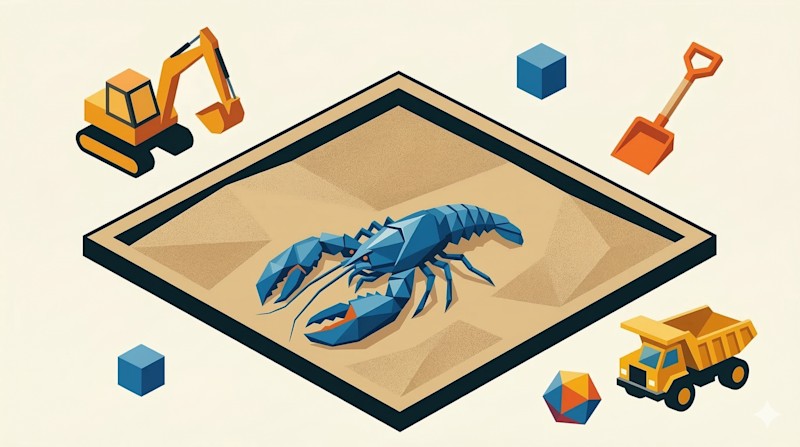
The emerging field of AI agents is rapidly shifting from experimentation to practical application. A key obstacle to enterprise adoption has been ensuring these powerful agents operate safely within business systems. To address this, NanoClaw, an open-source AI agent platform, is partnering with Docker to integrate its agents into Docker Sandboxes—a move designed to provide robust security for real-world deployments.
The Shift from Novelty to Deployment
For years, AI agents have demonstrated impressive capabilities in tasks like coding, question answering, and automation. However, the real challenge for businesses lies in safely integrating these agents with live data, file systems, and critical infrastructure. The core issue is preventing compromised or misbehaving agents from escalating into wider security incidents.
NanoClaw and Docker’s solution aims to provide a secure environment where agents can operate with maximum utility without compromising the host system. This partnership isn’t merely a packaging update; it represents a fundamental shift in how agent security is approached.
Infrastructure-Level Isolation
NanoClaw initially used Docker containers for agent isolation, but now leverages Docker Sandboxes, an enterprise-grade solution designed for secure runtime environments. This progression is crucial because agents fundamentally behave differently than traditional applications. They mutate their environments, install dependencies, and connect to external systems—breaking many of the assumptions built into conventional container workflows.
As Gavriel Cohen, NanoClaw’s creator, states, “You want to unlock the full potential of these highly capable agents, but you don’t want security to be based on trust. You have to have isolated environments and hard boundaries.” This emphasis on containment is critical; a compromised agent must not be able to expose credentials or access other agents’ data.
Why Agents Strain Conventional Infrastructure
Mark Cavage, Docker’s president and COO, explains that the traditional infrastructure model has become inadequate. “Agents break effectively every model we’ve ever known. Containers assume immutability, but agents break that on the very first call.”
The problem isn’t just about security; it’s about fundamental incompatibility. Agents require full mutability—the ability to install packages, modify files, and run processes—which contradicts the immutability assumptions of standard containerization. Docker Sandboxes address this by using MicroVM-based isolation, preserving familiar Docker workflows while providing stronger security boundaries.
A Layered Security Approach
Docker’s integration provides a “provably secure” environment where even if an agent misbehaves, the damage is contained. This aligns with NanoClaw’s original design philosophy, which emphasizes simplicity, auditability, and production readiness. Cavage stresses that security must be built into every layer of the stack: a secure foundation, a secure framework, and secure user-built applications.
The Rise of Multi-Agent Systems
The NanoClaw-Docker partnership reflects a broader trend towards deploying many bounded agents across teams, channels, and tasks. Cohen envisions a future where every employee manages their personal assistant agent, while high-performing teams operate hundreds or thousands of specialized agents.
This model emphasizes organizational systems design over the consumer-focused AI assistant paradigm. Agents will likely be assigned to distinct workflows with specific data access rights, requiring robust containment mechanisms.
Open-Source Collaboration and Strategic Alignment
Notably, this partnership is not driven by financial incentives but by technical compatibility. Docker developers discovered that NanoClaw integrated seamlessly into Docker Sandboxes without architectural changes. This suggests a genuine alignment in security concerns and design principles.
Docker plans to support other “claw” frameworks, but NanoClaw is the first official integration. The deeper significance is that the industry is shifting from model capability to runtime design. Enterprises need more than just intelligent agents; they need secure infrastructure to deploy them safely.
The Future of Agent Infrastructure
The NanoClaw-Docker integration offers a concrete blueprint for how enterprise agent infrastructure may evolve: open-source orchestration, MicroVM-backed isolation, and a deployment model centered on containment rather than trust. The AI industry must prioritize runtime security to enable practical, scalable deployments.
For organizations experimenting with AI agents, this partnership signals a move toward more secure, auditable, and manageable systems. The goal is not just to create capable agents but to ensure they can operate safely within real production environments.