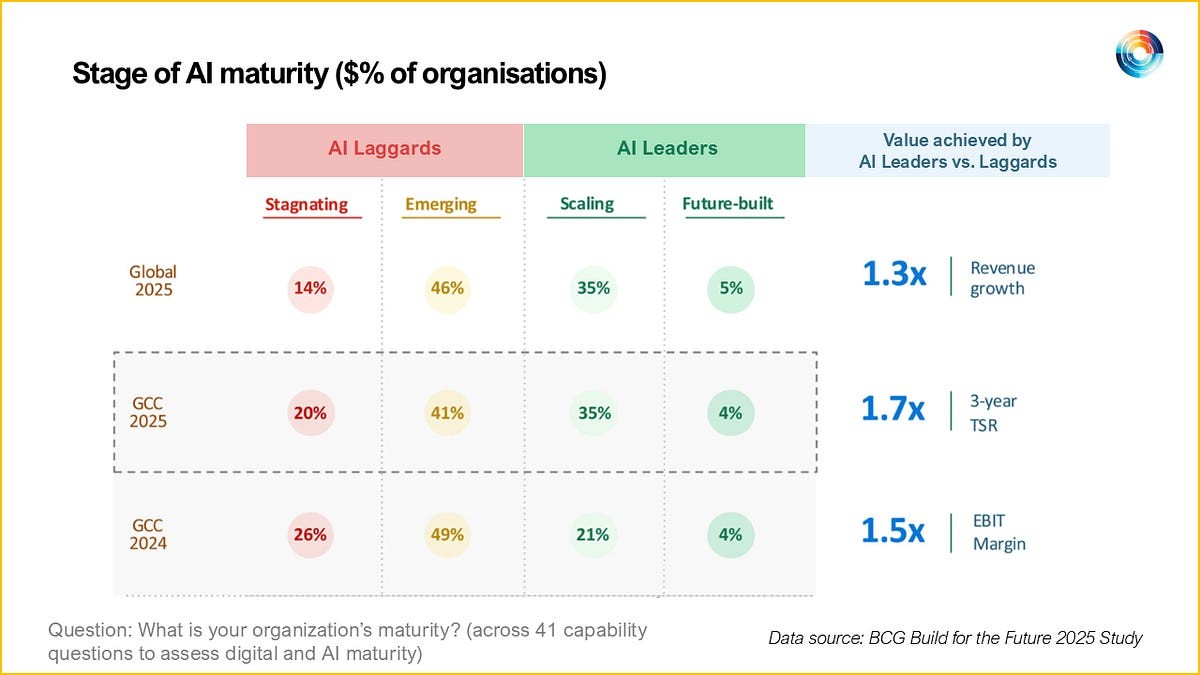
Gulf Cooperation Council (GCC) nations, particularly the United Arab Emirates (UAE) and Saudi Arabia, are rapidly establishing themselves as global leaders in artificial intelligence (AI) implementation, according to a new study by Boston Consulting Group (BCG). The research reveals that 42% of UAE organizations have reached “AI Leader” status, exceeding the global average of 40%, while Saudi Arabia matches the global benchmark at 40%. This demonstrates a clear regional trend: these countries are not merely experimenting with AI but integrating it comprehensively into their economies.
Accelerated AI Maturity in the GCC
The BCG study, which surveyed 200 C-suite executives across the GCC and assessed 41 digital and AI capabilities, found that AI maturity across the region has surged by 8 points between 2024 and 2025. The public sector within the GCC now exhibits the highest AI maturity levels worldwide. This growth isn’t accidental; it reflects deliberate investment and strategic planning.
Financial Impact of AI Leadership
The study highlights a direct correlation between AI leadership and financial performance. GCC organizations classified as “AI Leaders” achieve up to 1.7 times higher total shareholder returns and 1.5 times higher EBIT margins compared to those lagging in AI adoption. This economic advantage is driving further investment, with AI Leaders allocating 6.2% of their IT budgets to AI – significantly more than the 4.2% allocated by laggards. By 2028, the value generated by these leading organizations is projected to increase three to fivefold, widening the performance gap even further.
Key Strategies for Success
The BCG research identifies five critical strategic moves that differentiate AI Leaders:
- Long-Term Commitment: Pursuing multi-year AI strategies with sustained leadership engagement.
- Process Transformation: Fundamentally reshaping business processes, rather than relying on off-the-shelf solutions.
- AI-First Operating Models: Implementing robust governance frameworks for AI deployment.
- Talent Investment: Securing and upskilling AI talent at a higher rate than competitors.
- Fit-for-Purpose Architectures: Building technology infrastructure that facilitates seamless AI adoption.
Broad-Based Adoption Beyond Tech Sectors
While the technology, media, and telecom industries continue to lead in AI maturity, the study notes rapid advancements in financial institutions, healthcare, industrial goods, and infrastructure sectors. This demonstrates that the region’s AI transformation is not limited to tech companies but is becoming pervasive across diverse economic landscapes.
Experimentation with Agentic AI
The GCC is also actively exploring frontier AI technologies. 38% of organizations are already experimenting with agentic AI, positioning them competitively against the global average of 46%. The value generated from these initiatives is expected to double from 17% to 29% by 2028.
Challenges for Laggards
AI Laggards in the Gulf region face significant hurdles, including limited cross-functional collaboration, unclear value measurement, misalignment with enterprise strategy, and insufficient leadership commitment. They are 18% more likely to encounter these challenges, hindering their progress.
UAE and Saudi Arabia: Regional Frontrunners
The UAE’s success, with 42% of organizations now AI Leaders, is driven by strategic investments in AI infrastructure and its national AI 2031 Strategy. Saudi Arabia’s progress, with 40% of organizations achieving leader status, also demonstrates solid advancement. However, 27% of Saudi organizations remain in a “Stagnating” category, underscoring the potential for further improvement.
The GCC’s rapid AI adoption demonstrates the power of strategic investment and proactive implementation. The region is not just keeping pace with global trends but actively setting the standard for AI-driven economic transformation.
The region’s commitment to AI is proving both financially and strategically valuable, positioning it as a major force in the future of technology and innovation.