Drowning your drone is a special kind of pain.
It doesn’t matter if your quadcopter has collision avoidance, GPS home-return, or enough sensors to qualify as a robot. That gut-twinge of “what if I crash it into the lake” never goes away.
I got the new HoverAir Aqua. It’s built for water. I was still nervous.
Then I threw it off my kayak.
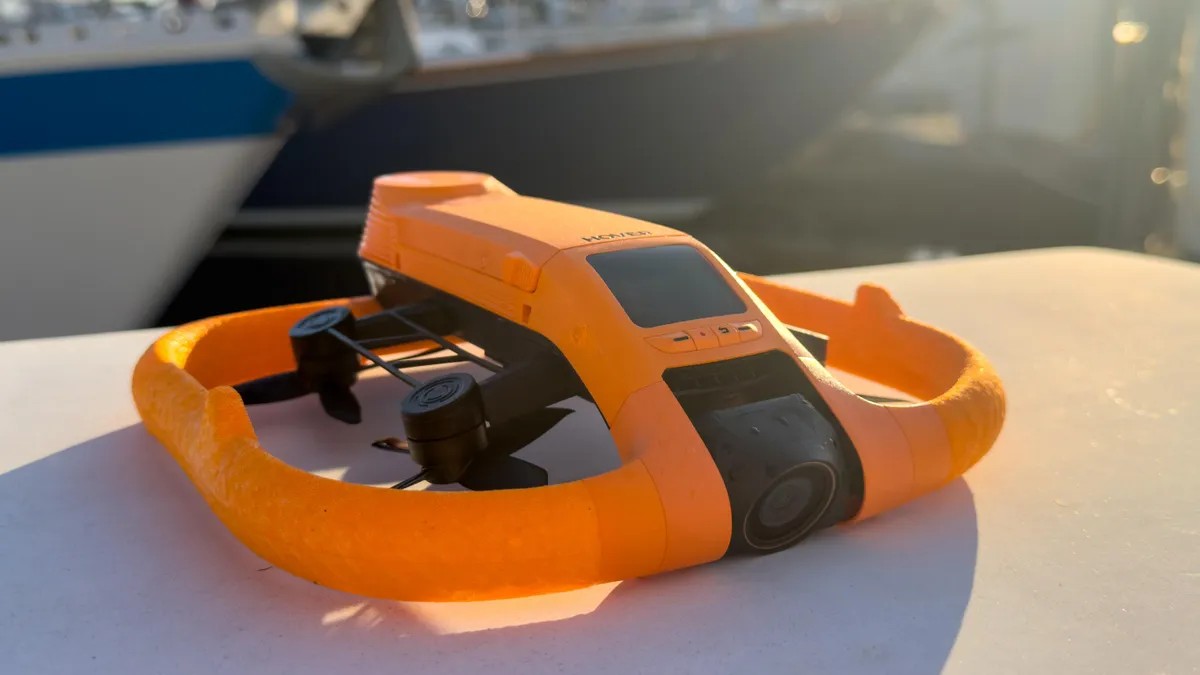
It floats. Actually floats.
The HoverAir Aqua isn’t just splash-resistant. It’s a flying camera meant to tag along while you surf, kayak, or paddleboard. You launch it. It watches you. You go do your thing. It’s not a submarine—don’t dunk it underwater—but it can peek below the surface while it’s bobbing before it lifts off.
Price? $1,299.
Here is the kicker: You can’t buy it in the US right now. Hover cites “administrative and regulatory complexities.” It’s shipping to fifty other countries. We are stuck in the weeds, as always.
The system is two pieces. The drone. The “Lighthouse.”
The drone weighs 249 grams. That’s deliberate. Just under the 250g FAA registration threshold. Clever. It has foam guards on the arms for buoyancy. The top is mostly battery and a small 1.6-inch AMOLED color screen. You toggle modes there. You check shots there.
The Lighthouse is the ugly duckling. A chunky orange brick. You strap it to your arm or leg. It talks to the drone wirelessly. One button launches. One button recalls. Four arrows let you nudge the camera up, down, left, right.
Both parts are IP-67 rated. Waterproof. Sealed. But you have to be careful. Plug the silicone cover on the charging port tight. Snap the battery latch secure. Electronics and water hate each other, no matter how hard engineers try.
Three batteries came with my unit. Plus two dry bags with double zippers. I shoved them into my life vest. The charger takes two batteries at a time via USB-C. Not waterproof, obviously.
“If the drone flips, it rights itself. You don’t have to swim out to save it.”
That feature is called Turtle Flip. I saw it in action when I tossed it in upside down for fun. It rolled over mid-air. Saved my finger. Or maybe just my pride.
Launch day
Seattle. A marina. Calm water.
I tossed the Aqua. Nervous. Then wet. Then fine.
The connection snapped. OmniTerrain mode locked. I pressed the button on my Lighthouse. Pop. Up it went. Loud. Sputtery. Four rotors chewing through air that just contained a lot of humidity.
The voice is loud. A cheerful female bot. She counts down. She warns you if you’re too close. She announces when she starts recording.
It works mostly on its own. That’s the point. Regular drones need your thumbs hovering over a controller. The Aqua just hangs around you. I used Kayak Mode. It stayed behind me, tracking my paddle strokes. You can set the distance—close, medium, far, or exact. It claims it can track you up to 34 miles per hour. I’m not paddling that fast in a rental kayak.
There are other modes too. Zoom Out. Orbit. Spiral. Stand-Up Paddle mode. Dolly Track.
It feels like having a cameraman who is slightly drunk but loyal.
The friction points
It wasn’t smooth sailing. Literally.
To land, I pressed “Return to Home.” It hovered nearby, waited 15 seconds, and dropped. Simple. But sometimes… it just stayed in the air.
Hanging. Burning battery. Doing nothing.
You have to grab it to force-land it by flipping it over quickly. But from a kayak seat? My reach was shorter than the drone’s hover height. Annoying.
The foam propeller guards? Fragile.
I clipped a fence in my backyard before I even hit the water. One guard cracked. It’s lightweight for a reason. No radar for the front, only a downward-looking sensor. If it hits something, it hits hard. Luckily, a repair kit comes in the box with spare props and guards.
I wanted more from the Lighthouse. It’s dumb on purpose, I guess. But no screen. No manual record button. Just waiting for the bot voice to say “Recording started.” I wanted to control that. I wanted buttons like the ones on the drone body.
And the firmware. It was prerelease.
“Fluctuations in signal strength caused disconnects. The drone would sway during Orbit mode.”
Hover told me this before I landed it. They didn’t hide it. I saw it too. Disconnects. Reconnections. Shaky footage. I emailed them. Waiting on answers.
Does the video suck?
Surprisingly, no.
The sensor is 1/1.28 inch. 4K at 60fps. Slo-mo hits 100fps. JPEGs, DNGs. Standard fare for the price.
You get 128GB of internal storage. No memory card slots. In my session, I recorded about 37 minutes of 4K video across 19 clips. That ate 15GB. You won’t run out on a half-day trip.
The lens is self-heating and hydrophobic.
Somehow, I still got smudges.
The image handled glare okay. Didn’t blow out the sky when I turned into the sun. But the motion? Jerky. It hunted for me. Panned hard. It’s not the ballet of a professional pilot flying a heavy DJI rig. It’s robotic. Clunky. But it frames you. And that’s what it’s supposed to do.
Final thought
The HoverAir Aqua fills a niche. Other drones? You treat them like glass. This one? You can toss it in a lake and pick it up by the nose.
There’s value in not worrying about a $1,000 mistake.
I just hope I remember which drone is which next weekend.
Because the regular one won’t forgive a dunk.