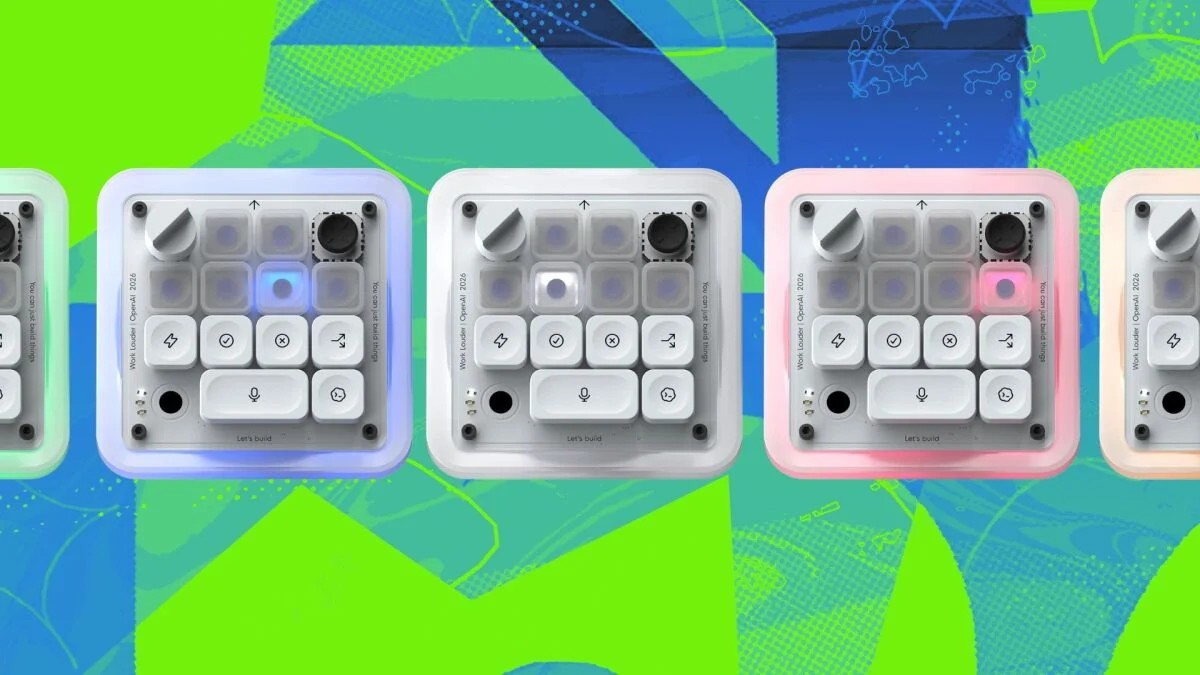
It’s here. Not the mysterious Jony Ive companion. Not a screen. A keypad.
OpenAI finally entered the hardware market with the Codex Micro, a 13-key mechanical peripheral priced at $230. You can pre-order it now via OpenAI’s new “Supply Co.” storefront. It ships around July 24.
If you were expecting the sleek, screenless AI companion rumored for years, this won’t be it. This is a collaboration with Work Louder, a peripheral maker, under their “Work Louder Co-Lab” banner. It is explicitly designed as a controller for OpenAI’s Codex coding assistant.
How the Codex Micro fits into your developer setup
The device isn’t a full keyboard. It is a compact dock designed to sit beside your main board. Think of it as a shortcut engine for AI-assisted programming.
It features specific hardware mapped to AI tasks:
- A rotary dial : This adjusts the AI’s “reasoning level” in real-time. Turn it to make Codex think deeper or faster.
- A joystick : Used to trigger workflows like reviewing pull requests or starting debugging sessions.
- Programmable keys : Dedicated buttons to accept or reject AI suggestions.
- RGB lighting : The backlight color shifts based on what Codex is currently doing in your code.
It connects via Bluetooth or USB-C. Out of the box, it supports both Mac and Windows. OpenAI included 32 interchangeable keycaps with every unit. That suggests they know developers are picky about their gear.
Why pay $230 for a keypad when standard keyboards cost a fraction? The promise is speed. Dedicated triggers for AI workflows remove the friction of mouse clicks and menu diving.
Which hardware does OpenAI actually want to sell you?
The launch feels disconnected from the other hardware effort floating around. Everyone talks about the “Jony Ive device.” That’s a screenless AI companion being built with former Apple design chief Jony Ive, whose startup io was acquired by OpenAI last year.
Reports suggest that device will track your surroundings and habits. It hasn’t launched yet. Meanwhile, the tech sector is still licking its wounds from Humane’s AI Pin and the Friend pendant. Both struggled badly. The AI hardware graveyard is getting crowded.
The Codex Micro avoids those pitfalls. It doesn’t try to replace your phone. It doesn’t track you. It just makes coding faster. Is it too narrow? Critics say yes. Reddit users questioned if the release was even a joke, pointing at the steep price for a gadget that serves a very small slice of developers.
But for someone living in their IDE? A joystick to debug? It sounds absurd. Then it sounds convenient. Then it feels necessary.
Who exactly is this for? The hardcore engineer. The one who treats their workstation like a cockpit. OpenAI is betting on a niche market. A deep, profitable niche.
They want to own the interface of your work. Not just your attention.
The keyboard sits on your desk. Quiet. Useless until you need it.
What happens when AI hardware stops trying to be smart and just helps you work?
Maybe nothing changes. Maybe everything does.
Note: Mashable is part of Ziff Davis. Ziff Davis filed a lawsuit against OpenAI in April 2025 regarding copyright infringement in AI training. This article covers the product launch regardless of legal context.